
What to Write Down After Every Doctor's Appointment?

You are in the parking lot, right after the last doctor’s appointment. Engine running, you are trying to remember what the doctor just said about your mom’s last blood test results. Frustration starts to creep in, which makes it even harder to concentrate. You had read so much advice online on what to ask your doctor and how to prepare for the appointment, but nothing on what exactly to do with the answers afterwards.
If you are managing a condition or helping a loved one, you have probably experienced the situation. The appointment anxiety, mixed with information overload and the time pressure of a 10-minute GP slot, for most people results in a blurred picture and information gaps, right after leaving.
Let’s take a look at what’s worth keeping in mind, and how to make it useful long after you have left the appointment.
What to capture in the first 10 minutes after leaving
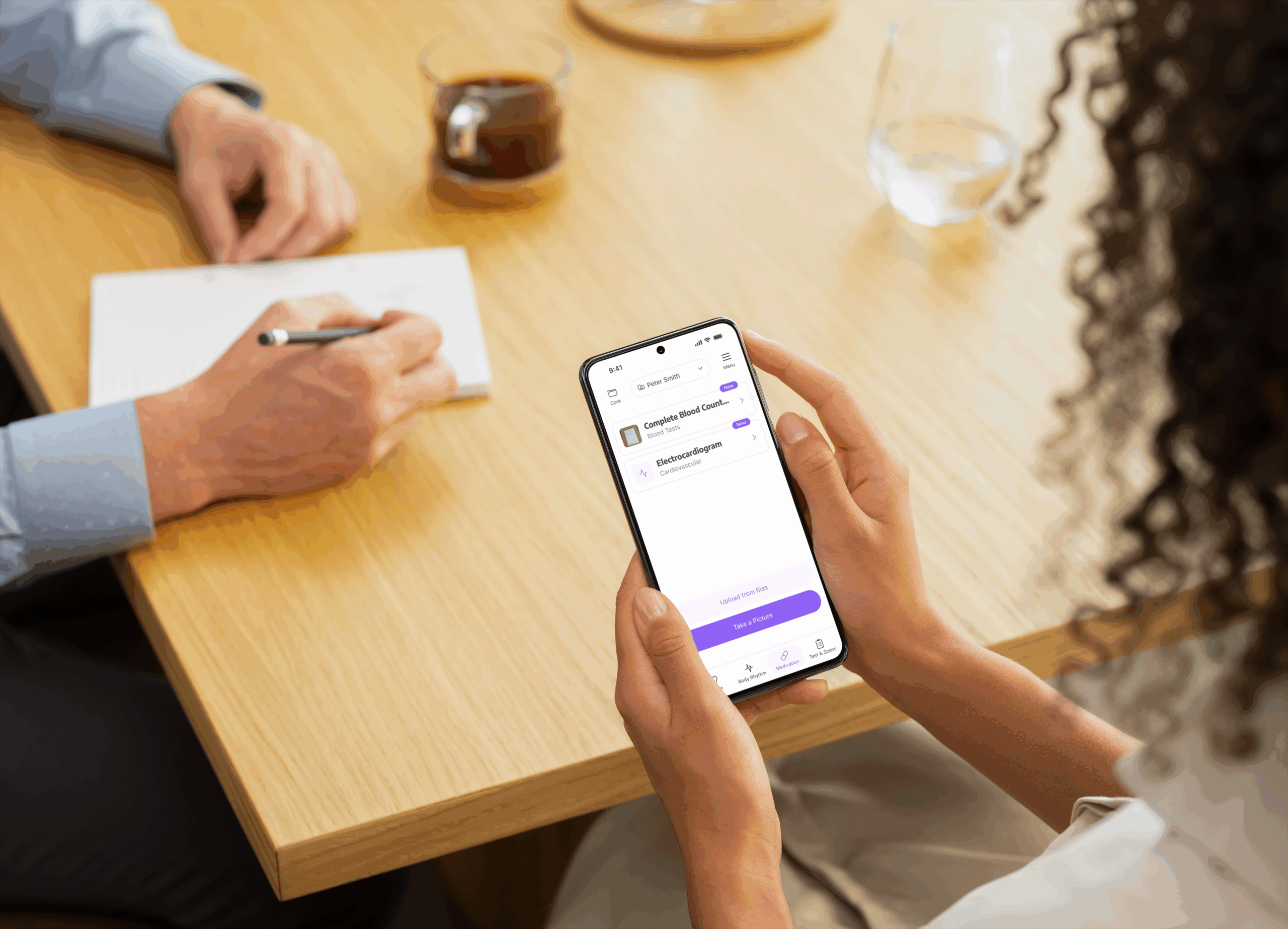
Your short-term memory works against you here. Under pressure, we tend to forget up to 80% of medical information immediately after a consultation. Once you step outside, it can be helpful to open your notes or reach for your phone.
If you can only do one thing, let it be this
In case you are short of time, one high-impact action can make a lot of difference. Record a 30-second voice memo on your phone, repeating out loud the new information, what’s next and anything that surprised you. Or take a picture of any instructions and prescription changes, jotting a quick note to yourself for each one of them.
A few things worth capturing after every visit
A clear checklist template can significantly reduce stress, help you feel more prepared, and make sure no important details are missed. You don’t need to write essays – just a couple of words against each of these will be enough to refresh your memory.
- Diagnosis or any condition changes – Here write down in simple terms what the doctor’s assumptions are, anything he is ruling out or worried about.
- Next actions – This is your to-do list with 4 points to consider after the appointment:
- Medication changes – names, new doses, frequency, what does it substitute (if anything).
- Tests needed – what tests and why, when to expect results.
- Referrals – name, specialty and reason.
- Follow-up appointment – a date for the next visit, or when to book one.
3. Red-flag symptoms – This is an important part that could be overlooked. Naturally, our attention goes to the tasks – take the medication, follow the prescription, book the tests. It is easy to lose track of the things that should not happen – the symptoms that are a sign to come back sooner, or visit the A&E. Write those down, even if they seem unlikely.
4. Questions – Here is where you can add anything that might have confused you or is not fully clear yet.
What your future self will thank you for keeping

A single appointment is just one piece of the puzzle. Your records across months are what tell a story. And stories help your doctors, and you, understand what is actually happening.
The pattern you can’t see
Long-term tracking and health organizing reveal details that are simply not visible through an individual appointment. Once you have all the puzzle pieces together in one place – symptom fluctuations across months and even years, reactions to medication shifts, test results with dates, questions or worries that keep coming up – you can track not just where you are today, but the direction your health is headed.
The goal is not to write down every small detail and turn your health management into a side admin job. The point is to become your best advocate, once you walk into your next appointment, to show up as an active participant in the conversation with your doctor. Instead of saying, “I think I may be feeling a bit better”, you will be able to say, “The dizziness significantly improved after 2 weeks of the new medication, but came back on week 5”. That specificity completely changes the outcomes and the whole experience.
It doesn’t need to be complicated at all. Consistency is what counts over time, not completeness. Especially for carers, a couple of key words against a date, can make a lot of difference a few months down the line, when your doctor asks when the symptoms started.
What to record if you are managing someone else’s health
If you are helping a friend or elderly parent manage their health, you are familiar with the challenge. It often involves tracking across multiple conditions, practitioners and family members, trying to stay informed. In this scenario, a tracking system becomes necessary – that could be a health log in your notes app, or a dedicated notebook.
Extra things it is helpful for a carer to capture after an appointment:
- Which doctor said what exactly. This is especially relevant for patients seeing multiple practitioners, to avoid later contradiction and confusion.
- How the person felt or reacted after the appointment, did they share anything they omitted in front of the doctor. This could be helpful in the next appointment and in piecing the whole health story together.
In this sense the carer has a unique perspective – continuously witnessing across appointments and daily life.
How to make these notes actually useful over time
Most people do capture something – a note here, a screenshot there. But all the scattered information does not allow you to see the shape of your health over a year. And the problem is not that we choose to be disorganized, we simply lack the right tools.
What can actually make your notes useful and tell their story is one consistent place – it can be physical, digital or both – a format you don’t need to overthink. Something you can share with your doctor, or family member without rummaging through screenshots and scraps of paper.
This is why we built Veraia. It is a personal AI health assistant for individuals, carers and families. One place to hold your complete health story, with you, at any time. It allows you to store any conditions, medications, documents, etc. in your full health profile – the Core. The Core works together with your Body rhythm, where you can log in your daily vitals and wellbeing. This is what allows patterns and tendencies to surface over time.
Even if you simply use your notes app, the habit of adding a date and category for each entry makes a huge difference to how useful it becomes. But of course, we’d be excited for you to try Veraia to store everything in one space.
So your health story is always with you and always makes sense.
Your appointments matter, and what comes after them matters just as much.