Какво е health tracking? Ръководство за начинаещи
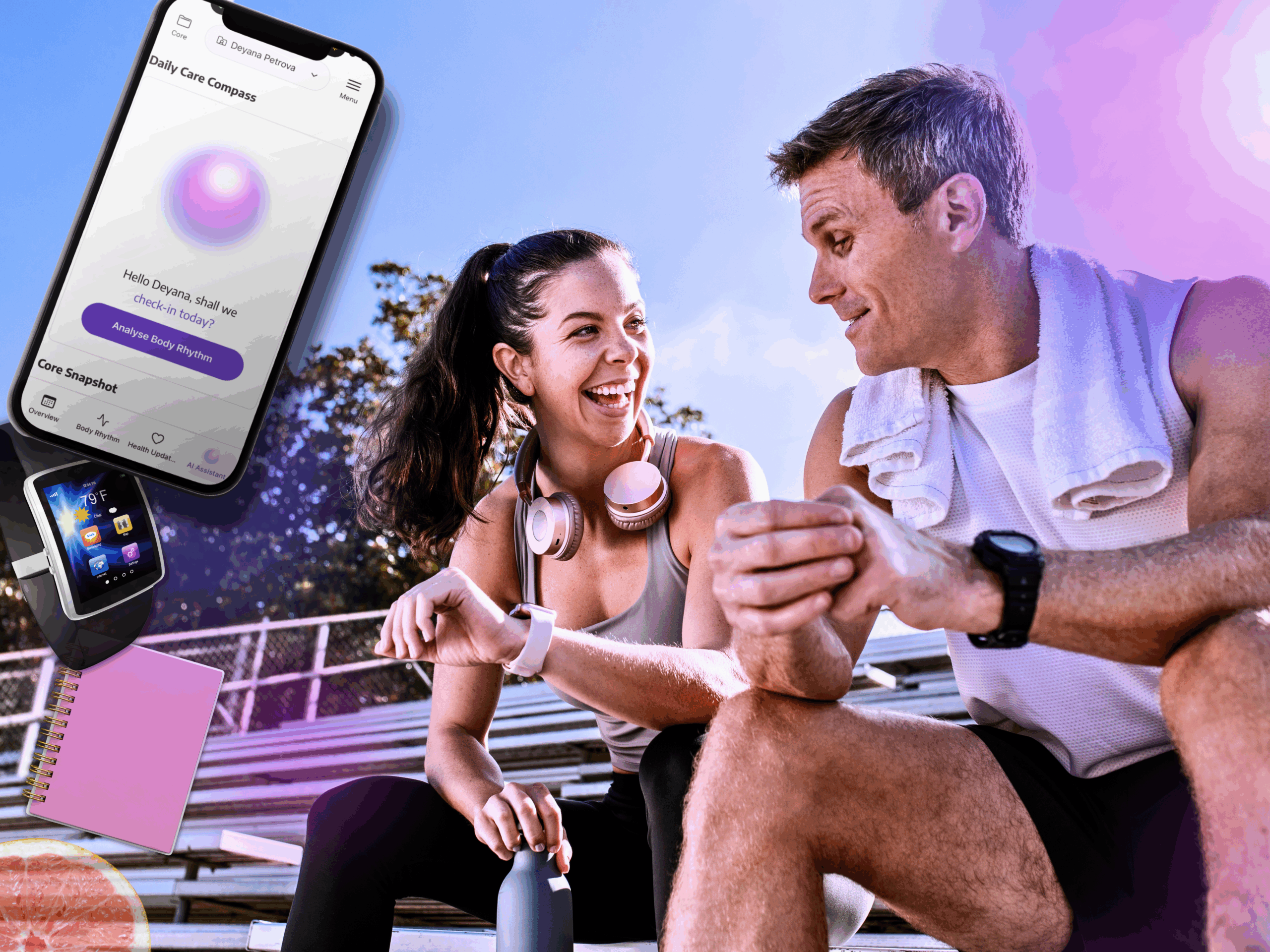
Health tracking used to mean something simple: a pedometer clipped to a waistband, a step count at the end of the day. Today it can mean dozens of different things – a recovery score built from overnight HRV, a continuous glucose reading, a mood log. Our pursuit of health has grown alongside the technology tracking it, and the word has naturally stretched to keep up.
It’s more common than most people realise: across the EU, nearly a third of adults used a wearable in the past three months, according to a 2024 Eurostat report. In the UK specifically, that figure climbs closer to half, per YouGov’s 2025 survey.
But there is a common misunderstanding. Most people assume that tracking something is enough on its own – that once a number is recorded, the work is done. It isn’t. This guide covers what health tracking actually is, the different forms it takes, and the real difference between collecting data and turning it into something useful.
What Health tracking actually means
At its core, health tracking is the practice of recording something about your body over time – vitals, symptoms, movement, medication doses or supplements – rather than relying on memory or a once-a-year check-up to tell the story. The goal is to notice patterns, monitor change, or support a decision. That’s the definition in full – everything else is a variation on those three purposes.
Self tracking is more diverse than most people initially picture. It includes wearable devices measuring physiological signals automatically, but also a paper symptom diary, a spreadsheet of blood pressure readings, a period tracking app, or a note on your phone logging how a new medication makes you feel. The tool matters far less than the habit of recording something consistently enough that a pattern can actually emerge over time.
A useful distinction worth making early: tracking a single reading is not the same as tracking a trend. A blood pressure reading today is a fact. A blood pressure reading logged consistently for six weeks is a trend – and it’s the trend, not the single fact, that tends to be useful.
What are the types of health tracking?
Health tracking isn’t one activity – it has several distinct categories, each suited to different goals and needs.
- Vitals and biometric tracking. Blood pressure, heart rate, glucose, oxygen saturation, temperature – the metrics people often picture first when they think of “health tracking.” Traditionally taken with a dedicated device and captured passively by a wearable in the background.
- Symptom and condition tracking. Logging flare-ups, pain levels, allergy reactions or known triggers for an ongoing condition. Less about a single number and more about a pattern of good days and bad ones and what causes them.
- Activity, sleep and lifestyle tracking. Steps, exercise, sleep stages, nutrition – the original category most people associate with “fitness trackers,” and often the entry point into health tracking generally.
- Mental health and mood tracking. Stress levels, mood logs, journaling. A newer category, but increasingly treated with the same seriousness as physical metrics rather than as an afterthought.
- Reproductive and cycle tracking. A category with its own dedicated apps and often looked at as something separate from “general” health tracking, despite being part of the same whole and drawing on the same underlying logic.
- Medical and administrative tracking. Medications, appointments, test results, vaccination history – rarely thought of as “tracking” in the wellness sense. It’s less about day-to-day self-monitoring and more about being able to find what a specialist said six months ago. It’s the category most directly useful in a clinical setting, since it’s the information a doctor actually needs.
- Tracking on someone else’s behalf. A parent logging a child’s symptoms, an adult keeping track of a parent’s medication schedule. Easy to overlook, because most tracking tools are still built around a single user tracking themselves.
These are all different inputs but with the same underlying question in every case: what does this actually look like over time? And most people who track their health seriously end up doing several of these at once, often across several different tools – which is itself one of the biggest practical challenges in the space.

Tracking isn't the same as effectively using what you've tracked
It’s entirely possible to track diligently for months and come away knowing barely more than when you started. This isn’t a failure of willpower – it’s a well-documented pattern. Research into self-tracking habits consistently finds that people are good at the collecting part and weaker at the part that follows: making sense of the collected data. Numbers accumulate, but understanding doesn’t automatically follow. It’s one of the more common reasons people abandon a tracking habit altogether – the log kept growing, but nothing about it ever became useful, so the sense of reward faded first. And none of it feels like a gap – the number is right there on the screen, so it feels like the job is done.
But the same gap shows up in medical records as well. A single blood pressure reading taken in a doctor’s office can look quite different from a reading taken at home on an ordinary day. That is exactly why guidance has shifted toward looking at readings over time rather than trusting any one moment in isolation. One number is a snapshot. A pattern tells a fuller story, closer to the truth.
This applies well beyond vitals. One rough night’s sleep doesn’t mean much. One low mood entry doesn’t either. A symptom that flares up once could be anything. It’s only when there’s enough logged in to compare and make connections that any of it starts to say something.
That comparison step is precisely the part most tracking tools leave to the person, without ever mentioning that it’s a separate job from the logging itself. And it is important for the end result.
None of this replaces a clinician’s judgement – reading a pattern and diagnosing what it means are still two different things, and the second one is a GP’s or specialist’s job. But noticing that a pattern exists is the first step.
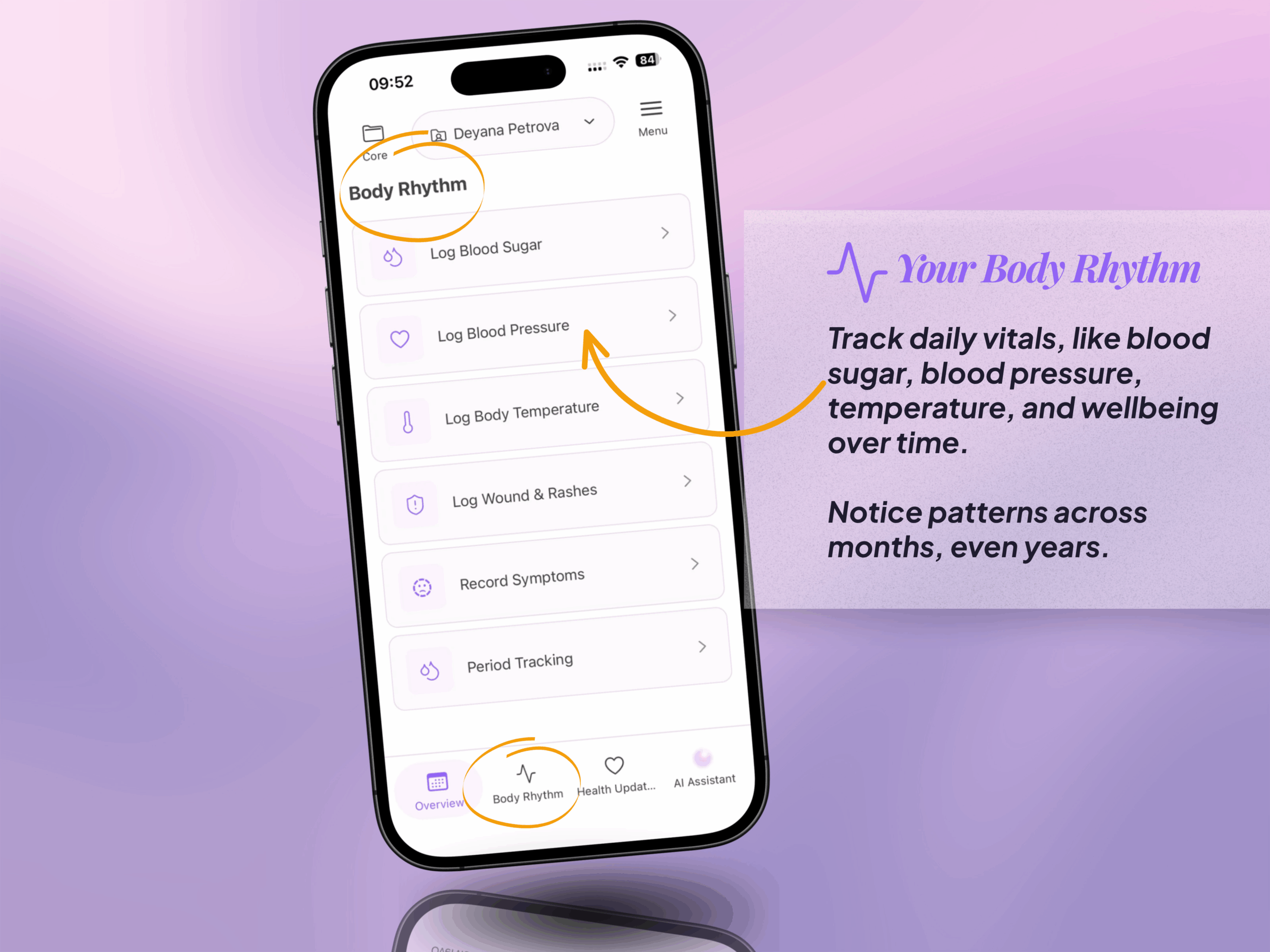
Getting the most from your own tracking
Making tracking useful, rather than just accumulated, comes down to a few practical habits:
- Track consistently rather than constantly – a few reliable data points logged regularly outperform obsessive, exhausting tracking
- Look for the trend and on schedule, not just when something feels wrong – a weekly or monthly look back is the simple thing that allows you to notice a pattern in your entries. Answers appear only when you look for them.
- Keep it in one place – connect what you track to everything else that’s true about your health, rather than letting it sit alone in a separate app. A pattern split across three apps and a paper notebook is a pattern nobody will ever actually see.
That last point is where most people’s tracking falls apart – not from lack of effort, but from having nowhere for it all to live together.
Veraia helps you connect the different parts of your health tracking
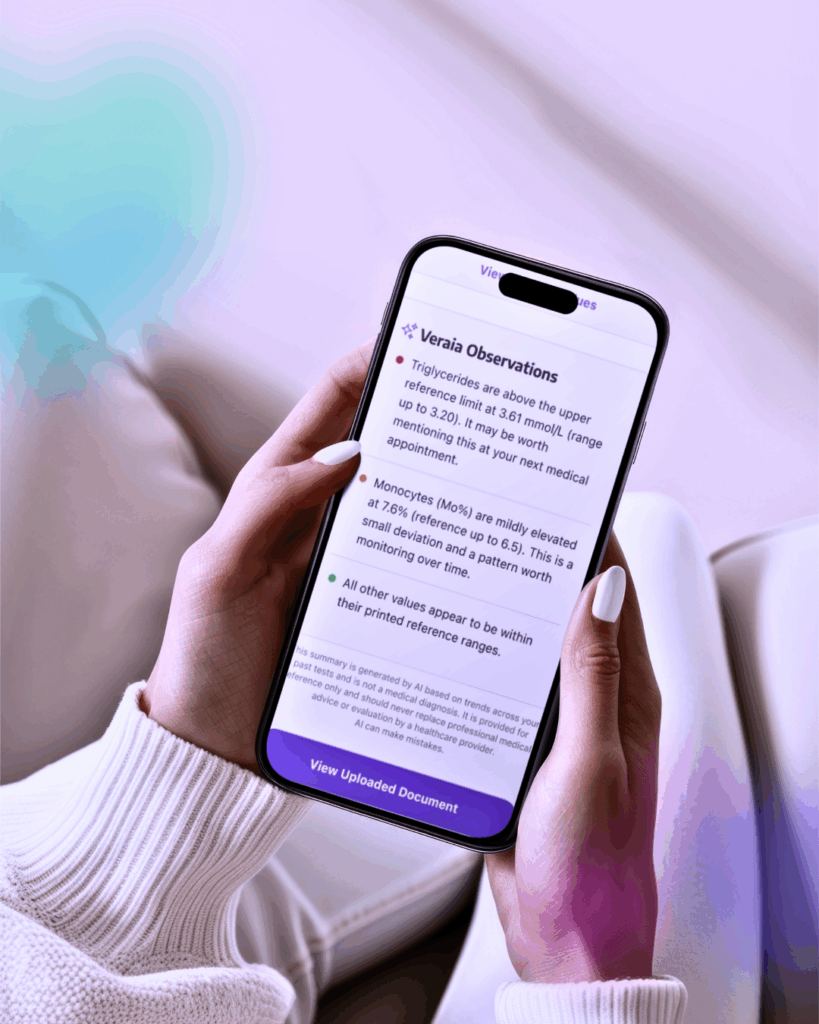
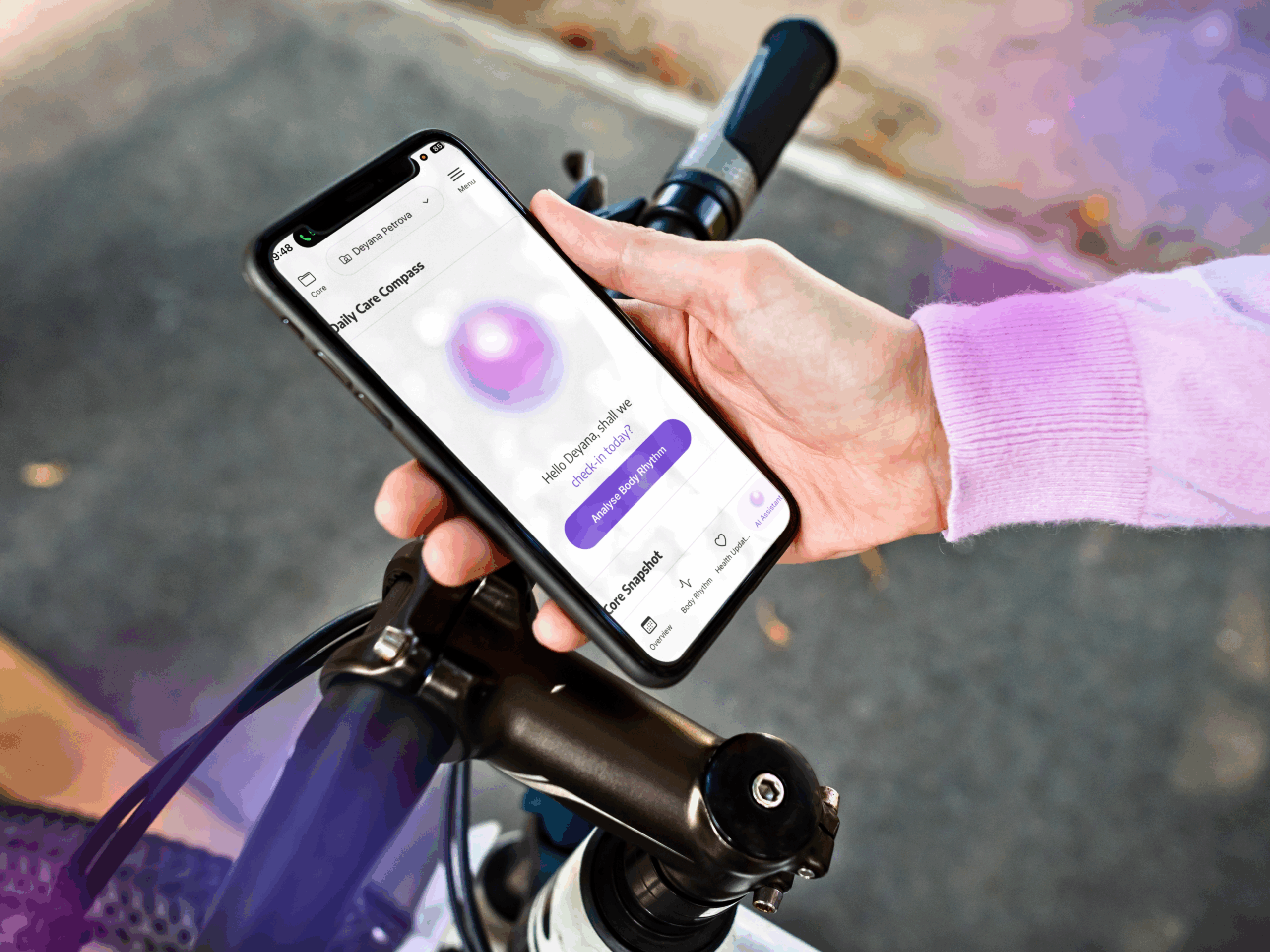
Most people’s health tracking ends up scattered: vitals in one app, a symptom noted in a different one, medication times in memory, a stack of test results. Veraia starts from a simple premise. It doesn’t compete with wearables, symptom trackers, or any single-purpose health app – it holds what those tools were never built to hold, and gives the data they collect somewhere to live and mean something together.
Вашият Ритъм is where daily readings, symptoms and wellbeing are logged alongside вашето Ядро: your conditions, medications, allergies, test results, specialist letters and documents, in one continuous timeline. Veraia Наблюдения help you connect the pieces and notice patterns across that combined picture – not just what your body is doing in the moment, but what that means next to everything else that’s true about your health.
None of this replaces a GP or specialist – Veraia doesn’t interpret a pattern clinically, and it doesn’t need to. It closes the much smaller, much more common gap: between tracking something, and actually seeing what you’ve tracked.
Health tracking, at its best, turns vague impressions into something you can actually see. At its worst, it becomes another set of numbers nobody ever looks back on. The difference was never the device. It’s whether the information ends up somewhere it can be organised and understood.

Author
Миа Димитрова
Junior Marketing Executive at Veraia
Hi, I'm Mia, Junior Marketing Executive at Veraia - your personal AI health assistant. Always curious about life and passionate about all things health, psychology and storytelling. You can often find me with a dog, a ukulele or staring at the stars.