What Is Health Information Overwhelm And How To Manage It?

A pile of test results you haven’t organised or made sense of yet, two appointments with your GP and a specialist, you are trying to coordinate, a medication change you are not completely sure about, and a Chat GPT thread, that might make you feel even more confused. We have all experienced that in one form or another – the feeling of being behind and not really knowing where to start. When it comes to health matters, that can also make you feel particularly vulnerable.
That feeling has a name – health information overwhelm. It’s what happens when the volume and complexity of your health information exceeds your ability to manage it – not because you’re not trying, but because nothing was designed to help you do it.
Let’s explore where it comes from, what it does to you, and how to actually make it better.
Health information overwhelm
Health information overwhelm is a paradox on its own. It occurs when the information received about your health, which is normally a good thing, is no longer helpful, but rather feels like a burden. It has absolutely nothing to do with a personality trait or lack of effort. It is a structural issue – the amount and complexity of health information most people are expected to manage has grown faster than any tool designed to help them do it.
The problem is not only about the information being too much. It’s also “filter failure” – the traditional ways of managing health information including folders, memory, scattered notes, are simply ill-suited to the reality of modern healthcare and the digital age. The system has reached a point where it generates more data than it helps you organise and keep track of. We are outgrowing it.
The numbers speak for themselves – only 20% of patients feel empowered managing their healthcare. 31% are not confident in navigating the health system. 28% of chronic disease patients manage two or more conditions simultaneously – each with its own pool of health data. Health information overwhelm is not an exception, but the dominant experience.
|
Health information overwhelm is the experience of having more health-related information to process, organise, and act on than your current capacity and available tools allow, leading to confusion, postponing, or anxiety. |

Where is comes from
Health information today normally arrives from more than a single direction. It comes from at least three at once, and it is common for most people to manage all of it simultaneously without a unified system.
Clinical information
One of the streams health data comes from is clinical information. That includes diagnoses, test results, medication changes, specialist letters, discharge summaries. They usually come in clinical language and often contradict previous information. Clinical information can also be very fragmented – a result here, a prescription there – with no clear connection between them. For anyone managing more than one condition or provider, this stream alone can exceed what anyone’s memory can hold.
Administrative information
This is the logistical layer of your health management – it is a lot less emotionally loaded than clinical information, but no less consequential. Appointment dates, prescription renewals, referral tracking, insurance documentation are included here, and missing a referral appointment for example, may mean that you lose the slot and have to wait for months. The consequences of not tracking the administrative stream of information can directly affect our health.
Online health information
The world we live in today provides an inexhaustible amount of information. And when we have a problem it is only natural to use the available resources to understand it better and look for solutions. Search results, forums, symptom checkers, social media, conflicting advice from well-meaning people. This stream is infinite and largely unfiltered. For someone recently diagnosed or managing an unexplained symptom, the urge to search is completely natural and the result is often more anxiety than clarity. This is the stream that can most directly trigger the feeling of overwhelm.

How it affects you
Healthcare overwhelm can manifest itself in different ways. The practical consequences can include avoiding or delaying important medical decisions. It happens that a medication isn’t taken correctly because the instructions were confusing. A follow-up appointment can get missed because the date was in an email from three months ago. Research identifies information overload as a significant predictor of not following a medication schedule, not because people don’t care, but because the cognitive load of managing it all eventually exceeds capacity.
The emotional consequences can vary from person to person but are usually what contributes most to keeping them in the loop of overwhelm. They often include exhaustion, anxiety, apathy and a specific kind of guilt. The feeling that you should be on top of this, that other people manage it better, that your inability to track everything is failing your own body and health. It isn’t. It’s simply a design gap.
For carers, this multiplies by a lot. You’re managing your own information and someone else’s – feeling the weight of responsibility for another person’s wellbeing. That is often across multiple conditions, providers, and with the emotional side of the relationship itself. The chronic illness literature names “diabetes distress” and “carer burnout” as real clinical experiences. Health information overwhelm is the practical layer underneath both of them.

How to manage it
The solution for health information overwhelm is not less information, and certainly not avoiding it. It is implementing a better management and structure of it. Let’s take a look at three principles that make the most practical difference.
Store in one place, not many
Scattered information is always overwhelming and stays so until organised. A single, consistent home for all your health information – could be a physical folder, a notes app or a dedicated tool – reduces the friction and the cognitive load significantly by just knowing where to find things. The format matters less than the consistency, but you could experiment and see which version works best for you.
Separate the streams of information
Clinical, administrative, and online information need to be handled differently. Clinical information should be stored in an accessible way and shared with your doctor when needed. Administrative information should be tracked so you don’t miss a deadline or an appointment. Online information should be filtered – always checked against trusted sources, discussed with a professional, not taken as a fact and acted on in isolation. Knowing which stream you’re in changes how you process it.
Prioritise and organise over time, not in the moment
Don’t try to process health information in the moment of overwhelm – in a doctor’s office, at 2am reading a test result – only concentrate on capturing what’s important. The antidote is building a system when you’re calm that works for you when you’re not. A health story that’s already organised before the moment you need it.
The Tool That Was Missing
The three principles we’ve mentioned above are simple enough. What has been missing so far is the tool that makes them effortlessly connect – one single place, already organised, already with you, anywhere you go, that doesn’t require you to build a system from scratch during a moment of overwhelm.
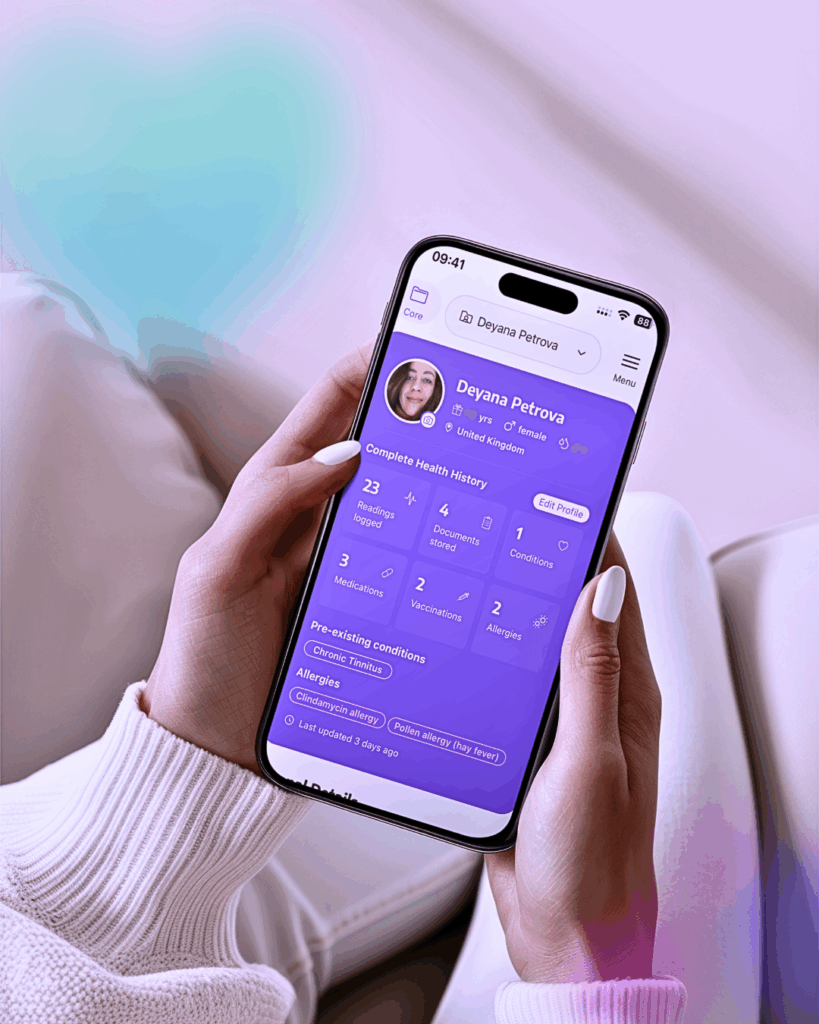
Veraia was built to be that place. A personal AI health assistant for individuals, carers and families – designed to be the memory layer that holds your complete health story. Your Core on Veraia stores all your health documents – conditions, medication lists, allergies, vaccinations, discharge summaries, blood tests, all medical history. Your Body Rhythm tracks patterns over time and based on all that data, Veraia Observations surface what’s worth noticing. Not to replace your doctors. To make sure you, and they, always have the full picture.
Health information overwhelm is real for many people. But it is not permanent and doesn’t have to be. The right system changes everything.